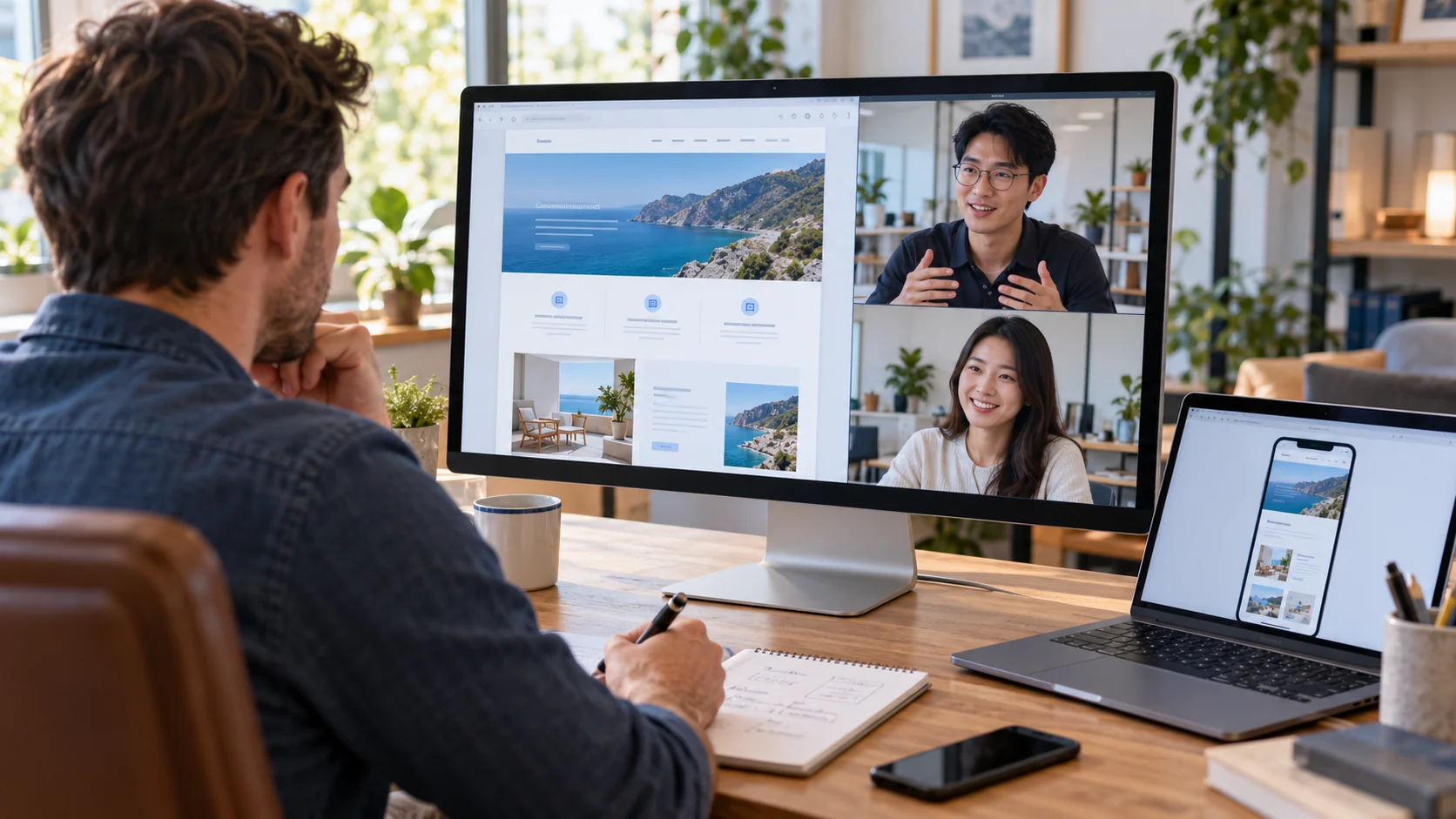
For a small business, a website is an important place for customers to understand your services, judge your professionalism and decide whether to contact you.
When planning a website, you will usually encounter two approaches: start with a ready-made template, or commission a design tailored to your business. The differences involve page structure, how your content is presented, and how customers find information and make an enquiry.
Understanding those differences can help you choose an approach that fits your business.
How do template and custom websites differ?
A template website starts with pre-designed pages. The business name, logo, images, colours and copy are then replaced. The main layout already exists, and your content is fitted into that structure.
A custom website starts with your business. Your services, customers and goals guide the page structure, visual design and functionality.
For example, someone visiting a roofing company's website may want to check its service area, see completed projects and request an estimate. A restaurant visitor may want to view the menu, check opening hours and reserve a table straight away.
These different needs influence what appears first on the homepage, which subjects need their own pages and where contact options belong.
- Page layout: templates adapt an existing structure; custom websites are planned around your business and content.
- Visual identity: templates offer a set range of adjustments; custom design is developed around your brand.
- Content presentation: templates provide spaces to fill; custom layouts are arranged around the material you need to show.
- Functionality: templates depend on the tools their platform supports; custom projects plan features around actual business needs.
- Future development: templates are influenced by their original structure and platform; custom planning can account for your next stage of growth.
When is a custom website a better fit for a small business?
When you want your website to explain your services accurately, build trust and encourage enquiries, custom design allows a more focused approach.
Your services need a clear explanation
If your business offers several services, customers need to understand what each includes, when it is relevant and how to enquire.
A renovation company, for example, might offer kitchen renovations, bathroom remodelling and whole-home projects. Clear content and dedicated pages help visitors find the information that matches their needs.
A custom website organises those services according to the way your business works, giving each one an appropriate place.
You have projects and experience worth showing
Project photos, descriptions of your work, team introductions and customer feedback help visitors understand your business.
A custom design can make the most of the material you have: before-and-after images to show a transformation, project details to explain the work, or a process section that shows customers what to expect.
The website can then demonstrate both what you have done and how you approach a project.
You want a website with its own brand identity
A business's identity is expressed through colours, typography, images, language and small details.
Custom design brings those elements together so that the website fits your logo, marketing materials and positioning. Customers receive a consistent experience whether they visit on a phone or a computer.
You need an enquiry process that fits your work
Different businesses need different information from a potential customer.
A contractor may need a project address, site photos and a service selection. A consultancy may need background information before arranging a call. A restaurant may need a menu and a connection to a reservation tool.
A custom website can organise forms and interactions around those needs, helping customers submit useful information and making follow-up easier for your team.
Your old website no longer reflects your business
As your business grows, an older website may fail to explain new services, leave projects out of date or make reading and contacting you difficult on a phone.
An outdated visual style can also leave a first-time visitor wondering whether the company is still actively trading. Even when your team is busy, an ageing website may struggle to communicate that energy.
A contemporary design, supported by up-to-date service information, real projects and team updates, can show customers that your business is active, attentive and investing in its future.
When redesigning a website, we reorganise its content and page structure and refresh the visual design to reflect the company's current services, capabilities and character.
How Roc Web Studio builds websites for small businesses
Roc Web Studio designs and builds websites around each business, its content and its target customers. We do not simply apply a complete ready-made website template.
We start by understanding the business, then connect planning, visual design, development and launch in a clear production process.
Planning starts with your business
At the beginning of a project, we learn what you offer, who your customers are, which areas you serve and what kinds of enquiries you want the website to attract.
We use that information to plan the pages, the focus of each page and the visitor's path from understanding your business to contacting you.
For an existing website, we also review the material you already have and reorganise it around your current needs.
Pages are designed around your brand
We use your positioning, logo, images and business content to develop the colours, typography, layouts and visual hierarchy.
Service descriptions, project examples and contact options are designed around the actual material, making the information easy to read and the important points easy to find.
Mobile design is part of the process too, including text sizes, image presentation, button placement and form interactions.
Specialists work together
Our team divides work across design, front-end development, back-end development and databases according to the needs of the project.
Design focuses on the visual presentation, while development handles implementation, functionality and data processing. Clear responsibilities help each stage connect smoothly, reduce repeated communication and improve production efficiency.
The delivery schedule is planned around the page count, feature complexity, readiness of your material and review progress.
Our cost structure supports competitive pricing
Our team is based in China. Local labour costs give us more flexibility in our cost structure, allowing us to offer competitive website pricing to small businesses overseas.
We define the scope around what the project needs, putting the budget into page design, content presentation and necessary features. Fees, deliverables and revision allowances are agreed before work begins.
Features follow actual needs
Depending on the project, we can build service pages, project showcases, contact forms and multilingual pages, and connect booking or other business tools.
For a website focused on presenting services and collecting enquiries, we keep the structure clear and interactions direct. Payments, memberships and more complex data features receive their own development plan.
Account ownership and handover are part of the project
At the start, we agree how domain, hosting and third-party accounts will be arranged. At handover, we provide the agreed website files, management access and instructions.
Your domain can be held in your own account. For any third-party platforms, fonts, images or paid services used in the project, we explain the relevant fees, licences and usage scope.
Before launch, we check page presentation, internal links, form submissions and mobile interactions. After launch, we can also provide content updates, issue resolution and further feature changes under the agreed service arrangements.
A website that fits your business
The most important consideration is whether your website explains your services clearly, demonstrates your capabilities and makes it easy for customers to contact you.
Custom design makes it possible to organise those elements around your actual business. From page structure and visual design to the enquiry process, each part supports your goals.
Planning a new website or considering a redesign?
Send Roc Web Studio an introduction to your business or a link to your current website. We will outline suitable pages and features, with a clear quote and production schedule.